Free will, fate, and chance
All the Light We Cannot SeeFree will, fate, and chance form a recurring moral and interpretive problem: are lives predetermined, governed by impersonal forces, or shaped by choices for which people remain responsible? The novel leaves that tension alive across a censored letter, Marie-Laure LeBlanc’s argument about a stone, and Werner Pfennig’s reckoning with what he did—and allowed to happen.
Determinism in a Censored Letter
A letter addressed to Jutta Pfennig invokes Frederick’s belief that no one has free will and that every person’s path is predetermined. Its surviving lines are fractured by censorship: even paper is difficult to obtain, and several passages have been obscured. The gaps make the letter itself an image of constrained expression, while its appeal to predestination survives as a question rather than a settled explanation. The writer refers to Frederick’s view and admits to a mistake, but the censor marks conceal what that mistake was. The text therefore connects determinism to responsibility without supplying a complete account: a belief that choices are impossible may shape how a person understands an action, yet the letter’s missing words prevent the reader from treating that belief as a full explanation.
The Stone and the Limits of Supernatural Fate
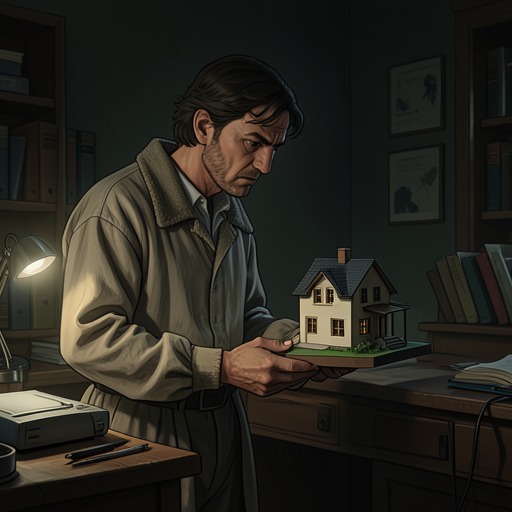
Marie-Laure counters the suggestion that the stone’s power explains why the house has escaped harm. She calls it a rock, a pebble, and points instead to luck—good or bad—and to chance and physics. Her reasoning refuses to turn survival into proof of a curse or protection. The house remains standing, but that outcome does not establish that the stone caused it. Her exchange with her father sets two accounts of events against each other: one searches for an intention or supernatural pattern, while the other accepts contingency and physical causes. The distinction matters because survival is not the same as safety. Marie-Laure’s father points out that she is alive; she answers that she is alive only because she has not yet died. Chance offers no promise that the next outcome will be favorable.
Werner’s Recognition of Choice
Later, Werner Pfennig’s thoughts bring Frederick’s determinism into direct contact with moral responsibility. Remembering Frederick’s claim that people do not choose and do not own their lives, Werner recognizes that he himself acted as though it meant there were no choices. He recalls watching Frederick dump the pail of water at his feet, then standing by as consequences fell on Frederick. The memory turns an abstract argument about fate into an account of a specific failure to act. Werner extends that recognition to his repeated observation of Frank Volkheimer entering house after house in a recurring scene of violence. The recurrence does not make those actions inevitable in Werner’s reflection; instead, it sharpens his awareness of what he witnessed and of the excuse he had made for himself. His thinking shifts from whether choice exists in theory to the burden of the choices he pretended not to have.
Chance, Agency, and Accountability
These moments do not reduce every outcome to human will. Marie-Laure’s appeal to physics and luck preserves the force of events beyond anyone’s control, while the censored letter presents a deterministic belief whose supporting context is partly lost. Werner’s retrospective judgment, however, prevents uncertainty about fate from erasing responsibility. The idea that a person may lack control over much of life does not make witnessing harm, or failing to intervene, morally weightless. The concept thus remains deliberately unresolved but not morally neutral. Chance explains why survival cannot be taken as proof of supernatural protection; determinism explains how people may describe themselves as powerless; Werner’s memory exposes the danger of using that description to avoid owning a choice. The novel holds these claims together without making them equivalent.